Countdown to the eFTI Regulation: One Year Until Full Implementation
15 Jul 2026


While Spain is busy preparing for the introduction of the digital control document (DeCA) for freight transport, in Europe, the countdown has already begun for the final implementation of the eFTI Regulation, which stems from Regulation (EU) 2020/1056 on electronic freight transport information.
One year from now, on July 9, 2027, all competent authorities in the Member States must be prepared to receive and process electronic transport information through certified platforms.
The digitization of transportation documentation has been progressing for years at varying paces depending on each country and its regulations. However, the eFTI Regulation marks a turning point for the European logistics sector, as it establishes a common framework for the electronic exchange of information related to freight transport.
As July 2027 approaches, transportation companies, logistics operators, shippers, and especially government agencies must prepare for a scenario in which paper documents will gradually give way to digital data that is accessible in a secure and standardized manner.
The eFTI (electronic Freight Transport Information) Regulation is the European regulation designed to facilitate the electronic exchange of information on the transport of goods between companies and competent authorities, whether by land, air, or sea.
Adopted by the European Union with the aim of promoting the digitization of the sector, the Regulation establishes the conditions under which authorities must accept transportation information submitted in electronic format.
Its purpose is to eliminate administrative barriers, reduce the bureaucratic burden associated with document management, and promote greater efficiency in logistics operations.
To this end, it establishes an ecosystem based on certified platforms capable of storing, sharing, and making the information required during inspections or audits available to the authorities.
It is important to note that the eFTI Regulation does not currently require companies to generate all their transport documentation in electronic format. What it does establish is the obligation for public administrations to accept such information when it is submitted through systems that meet the requirements defined by the regulation.
The model set forth in the Regulation is structured around three legally defined elements:
So, the information will be stored on secure, certified digital platforms that are integrated with the companies’ management systems.
The data will remain under the control of the operators and will only be shared when requested by an authority during an inspection or audit, using secure mechanisms and machine-readable formats —such as QR codes—through the eFTI Gates that each country will implement. SIMPLE in the case of Spain.
In addition, eFTI platforms will enable selective information sharing with customers, suppliers, and other authorized partners in the logistics chain, granting them customized access rights.
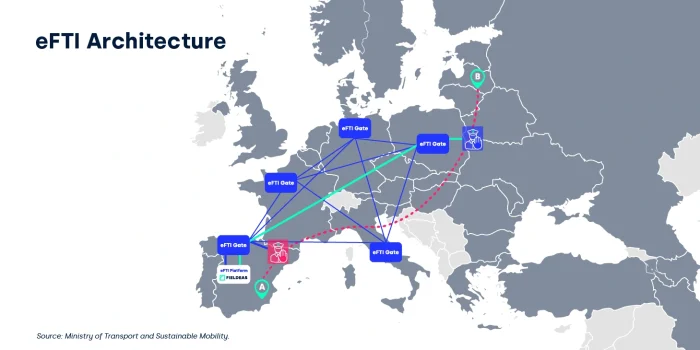
The implementation of the eFTI Regulation will bring benefits to both businesses and public administrations.
Digitizing documentation will reduce the administrative burden and costs associated with paper-based processes. In fact, the European Commission estimates that the transportation and logistics sector could save around 1,000 millones de euros per year.
In addition, the instant exchange of information will make it possible to optimize logistics planning, improve coordination among the various stakeholders in the supply chain, and facilitate faster and more efficient decision-making.
Government agencies will be able to conduct compliance checks more quickly and efficiently, reducing the number of physical inspections and the costs associated with them.
Furthermore, access to more structured and higher-quality information will help improve the monitoring of transportation policies and the oversight of logistics activities.
Overall, the eFTI represents a decisive step toward a more digital, efficient, and sustainable freight transport system.

The digitization of transportation documents is not governed by a single set of regulations. Currently, there are various initiatives that, although operating in different geographic areas, are moving in the same direction: eliminating paper and replacing it with electronically stored information that is fully legally valid.
The Digital Administrative Control Document (DeCA) represents Spain’s step toward modernizing document management for road freight transport.
Its goal is to simplify the processes for exchanging information between businesses and government agencies.
The eFTI Regulation establishes the European framework that will enable authorities to accept transport information in electronic format.
Although it is a community initiative, its effects directly impact Spanish companies operating within national and international logistics chains.
Internationally, the eCMR protocol is one of the cornerstones of the digitization of transportation documents.
Currently, 42 countries are parties to the protocol. This means that they recognize the legal validity of the electronic transport document and accept the digital exchange of information associated with the bill of lading.
The combination of DeCA, eFTI, and eCMR paints a picture in which paper-based documentation will gradually disappear in favor of more efficient, traceable, and sustainable processes.
The implementation of the eFTI Regulation underscores the need for technological solutions capable of managing electronic documentation in a secure and interoperable manner, and that are prepared to meet current and future regulatory requirements.
In this context, the Smart Docs Hub document digitization module from FIELDEAS Track and Trace enables the digitization, management, and sharing of shipping documents throughout the entire logistics chain, facilitating the transition to fully digital models.
Smart Docs Hub helps all stakeholders in the supply chain eliminate paper-based processes, automate document workflows, and ensure real-time access to information—all based on two essential pillars: legal certainty and flexibility.


14 May 2026
Difference between consignment note, CMR and control document

16 Jun 2026
FIELDEAS takes part in the expert group led by the IRU to promote the interoperability of the eCMR

25 Jun 2026
DeCA: FAQs on the Electronic Administrative Control Document