Mandatory Digital Control Document: Regulations, Deadlines, Exceptions, and How to Digitize It
16 Jun 2026



The mandatory digital control document (DeCA) is now a reality in Spain. As of October 5, 2026, the entire road freight transport sector must use the control document in electronic format, which is the only mandatory option.
The passage of the Sustainable Mobility Act in November 2025 has led to the mandatory digitization of the control document, as set forth in the eighth transitional provision.
In this post, we’ll take a look at the regulations, deadlines, exceptions, and how to digitize the control document correctly and securely.
The administrative control document is regulated by Order FOM/2861/2012.
According to Article 3, “the control document is an administrative document that must be carried on board the vehicle and accompany the goods during transport.”
It also establishes that, in the case of continuous transport contracts, a control document must be issued for each shipment carried out under the contract.
Its electronic version, the DeCA, is governed by these same regulations and also complies with the specifications set forth in the June 2026 amendment to the ROTT, resulting from the June 5, 2026, Resolution of the General Directorate of Road and Rail Transport.
October 5, 2026, is the effective date for the mandatory use of the electronic Administrative Control Document (DeCA) for the public transport of goods by road.
This requirement stems from the eighth transitional provision of the Sustainable Mobility Act, which established a ten-month transition period for the sector to adapt its processes and systems to the new digital documentation. Once that period has ended, the control document must be issued and managed in electronic format in accordance with the requirements set forth in the regulations.
The mandatory use of the DeCA applies to domestic road freight transport, including cabotage services carried out within Spanish territory. Its purpose is to improve the traceability of transport operations, simplify document management, and facilitate monitoring and inspection by government authorities.
The following are required to complete the control document:
However, there are exceptions to the use of digital control documents, including:
Furthermore, the regulations emphasize that in cases where the transport is documented in a bill of lading or other supporting documentation that complies with applicable national, European Union, or international legislation on the matter, such documentation shall serve as an administrative control document provided that it contains all the information listed in Article 6 of Order FOM/2861/2012.
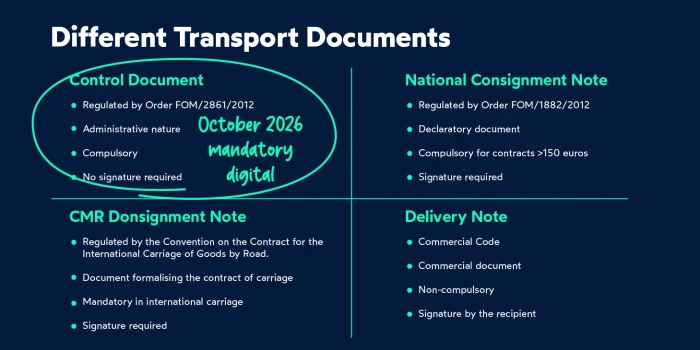
We already know what the control document is and that it is mandatory to digitize it, but under what guidelines?
In fact, the digitization of transportation documents has been supported for years, although it was the amendment to the ROTT in June 2023 that established the requirements ensuring its feasibility.
Now, a new amendment to the ROTT (June 2026), resulting from the June 5, 2026, Resolution of the General Directorate of Road and Rail Transport, has expanded the requirements that systems and the DeCA must meet to be fully valid:
Read the post “Mandatory Digital Control Document (DeCA): What It Is and How to Digitize It ” at to learn in detail about all the requirements that must be met when digitizing the DeCA to ensure its validity.
The Smart Docs Hub document digitization module from FIELDEAS Track and Trace ensures that any company in the transportation sector can generate, manage, and retain control documents with full legal validity and maximum operational efficiency.
This solution is designed to strictly comply with the requirements established by Order FOM/2861/2012, the ROTT, the eCMR Convention and the eFTI Regulation, so that the entire document process, from creation to roadside inspection, is carried out with full legal and regulatory guarantees.
Smart Docs Hub automates the collection of required data, prevents omissions or errors, and allows the control document to be integrated into the digital workflow of shippers, carriers, and logistics operators.
In addition, it incorporates advanced electronic signature systems that meet the criteria of identification, linkage to the signer and document integrity.
Furthermore, thanks to its verification, secure storage, and immediate accessibility features, Smart Docs Hub ensures that the control document is always available and easy to locate.
This makes the process a legal, secure, efficient, and sustainable mechanism, ensuring that any company that adopts this solution will be fully prepared for the mandatory implementation of the digital control document in October 2026.

Marketing Manager at FIELDEAS


06 Jul 2026
eCMR in Spain: complete guide to the digital international consignment note, regulation and time horizons

21 May 2024
Different transport documents: eCMR, consignment note, control document and delivery note

22 Jan 2025
Countdown to mandatory eCMR: eFTI and Sustainable Mobility Law

11 Jun 2025
Document digitisation in the transport of dangerous goods: ADR 2025