How to strengthen data security with digital forms
17 Oct 2025



The digital transformation of industrial operations has driven the adoption of digital forms or smart forms to capture and manage information in the field. In this environment, ensuring data security with digital forms becomes a strategic priority: data must be reliable, protected against unauthorized access and kept intact throughout its lifecycle.
Implementing secure digital solutions not only responds to regulatory requirements, but also ensures that digitization translates into operational efficiency without compromising the confidentiality of information.
Digital forms make it possible to record data from mobile devices, incorporate photographs, geolocation, electronic signatures and other elements that enrich traceability. However, this advanced collection capability also implies new challenges in terms of cybersecurity and information protection.
Talking about data security with digital forms implies applying a set of measures to protect the information in three fundamental axes:
These principles ensure that the information collected is useful, reliable and verifiable, providing value in audits, decision making and regulatory compliance.
Although digital forms offer great advantages, their management without the proper precautions can expose companies to different types of risks:
These risks demonstrate that security must be an essential component of the design of any digital forms system.
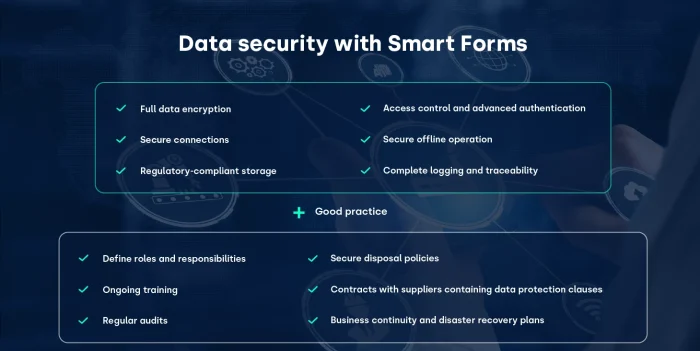
There are multiple technical and organizational strategies that strengthen data protection in digital environments:
End-to-end encryption ensures that information is protected from the moment it is captured, during its transmission and while it is stored. Thus, no third party can read or alter the data without authorization.
The use of secure connections (such as HTTPS) and digital certificates prevents server spoofing and reduces the risk of attacks during communication between devices and servers.
Storing data on servers that comply with GDPR and other local regulations ensures legal and technical protection of the information.
Defining permissions by role and applying double-checking mechanisms reinforce security, preventing unauthorized access or unauthorized modifications.
In environments where connectivity is not constant, digital forms must be able to operate offline with the same level of security, synchronizing information only through secure channels.
The collection of metadata, such as date, location or user, makes it possible to audit processes, identify incidents and comply with control and transparency standards.
Ensuring data security with digital forms goes beyond technology. It requires a combination of internal policies, training and organizational culture oriented to information protection:
A comprehensive strategy in this area generates confidence in clients, auditors and partners, reinforcing the reputation and efficiency of the organization.
The FIELDEAS Forms platform has been specifically designed to ensure data security in the use of industrial digital forms, combining ease of use with a robust and compliant infrastructure.
Our no-code solution protects information from capture to storage, with advanced encryption mechanisms and secure transmission, without the need for complex configurations.
With FIELDEAS Forms, your company can digitize its processes with total confidence, ensuring that every piece of data is protected, traceable and available only to those who need it.



18 Sep 2025
Online forms in inspections and certifications: the key to optimize business management

25 Sep 2025
How smart forms help you reduce costs and eliminate errors

02 Oct 2025
How digital forms in food quality improve safety

10 Oct 2025
Practical guide to integrate online forms in your company