How digital forms drive sustainability in industry

31 Oct 2025

Digital forms and sustainability_FIELDEAS Forms

Digital forms have gone from being a simple operational tool to become an essential component of industrial sustainability strategies.

Beyond replacing paper, its use transforms the way organizations collect, manage and analyze information, facilitating compliance with ESG objectives and the adoption of more responsible production models.

The digitization of processes through digital forms not only eliminates the physical support: it also streamlines management, reduces human errors, optimizes resources and improves traceability. All this translates into lower energy consumption, less waste and reduced environmental impact.

The environmental value of digital forms

We have already analyzed in the post Main benefits of digital forms for companies the capacity of smart forms to improve the productivity of companies. In this post, we are going to focus on their contribution to the achievement of their sustainability objectives.

Digital forms act as a bridge between technological innovation and environmental responsibility, helping companies to:

  • Comply with decarbonization and circular economy commitments.
  • Advance in sustainability audits and certifications.
  • Enhance your corporate reputation with customers and investors.

In this sense, integrating digital forms goes beyond efficiency and is not just a technological decision: it is a commitment to innovation and to the planet.

Each process that is digitally transformed implies a more efficient use of resources, a decrease in emissions and a more accurate management of environmental impacts. In this way, digital forms are consolidated as an essential ally for industries seeking to minimize their social and environmental footprint.

How digital forms help reduce emissions

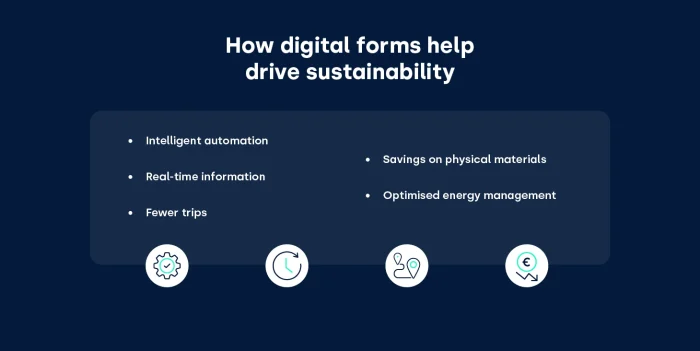
The positive environmental impact of digital forms arises from their ability to automate, connect and optimize. Below, we explain some of the factors that explain their contribution to sustainability:

  • Intelligent automation: by eliminating manual steps and validating data at source, errors that generate rework and unnecessary energy consumption are avoided.
  • Real-time information: having up-to-date data makes it possible to make decisions that reduce waste, adjust consumption and prevent failures.
  • Less travel: tasks such as inspections or revisions can be performed from mobile devices, avoiding travel and emissions associated with transportation.
  • Savings in physical materials: the elimination of paper means lower expenses in printing, storage, logistics and waste management.
  • Optimized energy management: with digitized data, it is easier to detect resource leaks and implement corrective measures quickly.

Digital forms are not only a substitute for paper; they are an active tool to reduce emissions and build more sustainable value chains.

Examples of sustainable use of online forms

Several industrial sectors are already taking advantage of the potential of digital forms to reduce their environmental impact:

  • Manufacturing: digital control forms avoid unnecessary stops, minimizing energy consumption and wasted materials.
  • Logistics: forms for deliveries or maintenance allow optimizing routes, reducing travel and shortening delivery times.
  • Construction: digitized documentation streamlines supervision and eliminates the need for physical transport of files.
  • Energy and utilities: digitization of inspections helps to detect failures before they lead to additional losses or emissions.

In all cases, the use of smart forms translates into the same equation: less consumption, less travel and more control over resources.

If you want to know more sectorial examples, you can read the post Digital forms for different business sectors.
How digital forms help drive sustainability_FIELDEAS Forms

Best practices to maximize the environmental impact of digital forms

The adoption of smart forms is a key step towards sustainability, but their real impact depends on how they are designed and used. Some recommendations:

  1. Intelligent design: including only relevant fields and automating conditional logics reduces unnecessary data processing.
  2. Sustainable synchronization: scheduling updates and information delivery at times of low energy load improves efficiency.
  3. Continuous monitoring: measuring environmental indicators associated with digitization allows demonstrating progress in sustainability.
  4. Staff training: proper use ensures fewer errors and maximum utilization of environmental benefits.

By applying these practices, online forms become a tool with measurable impact on carbon footprint reduction.

How FIELDEAS Forms boosts corporate sustainability

FIELDEAS Forms digital forms software drives the achievement of sustainability goals, as well as simplifying and optimizing field data collection in industrial environments.

Among the main advantages provided by FIELDEAS Forms are:

  • Personalized and paperless forms: the creation of fully digital flows eliminates the use of paper and associated materials, reducing waste and logistics footprint.
  • Mobile and offline operation: workers can record information from anywhere, even offline, avoiding unnecessary travel and optimizing the use of resources.
  • Integration with business systems: the data collected is automatically synchronized with management systems, eliminating duplication and enabling analyses that help to optimize energy and material consumption.
  • Enriched evidence capture: the possibility of including photos, geolocation, QR codes or digital signatures guarantees traceability without the need for physical support, simplifying audits and certifications.
  • Scalability and adaptability: FIELDEAS Forms adapts to different sectors and regulations, ensuring that each company can digitize processes with a low implementation impact and tangible results in sustainability.

Thanks to its comprehensive approach, FIELDEAS Forms is positioned as a strategic ally for companies seeking to reduce their environmental footprint, strengthen their ESG policies and improve their industrial competitiveness.

Sustainability in industry with digital forms_FIELDEAS Forms
Subscribe to our blog and newsletter, and keep up to date with the latest news on digital transformation and innovation affecting your sector.
Subscribe

Lola Hurtado

Marketing Manager at FIELDEAS

Linkedin iconEmail icon
More related information
Digital forms for food quality_FIELDEAS Forms

02 Oct 2025

How digital forms in food quality improve safety

In the food industry, quality is non-negotiable: it is a legal requirement and a commitment to consumer safety, brand reputation and process efficiency. Thus, the digital forms in food quality...
Integrate online forms into your business_FIELDEAS Forms

10 Oct 2025

Practical guide to integrate online forms in your company
More and more companies are opting to integrate online forms to modernize their internal processes. Paper documents, in addition to being slow and difficult to manage, are often a source...
Data security with digital forms_FIELDEAS Forms

17 Oct 2025

How to strengthen data security with digital forms
The digital transformation of industrial operations has driven the adoption of digital forms or smart forms to capture and manage information in the field. In this environment, ensuring data security...
Benefits of using FIELDEAS Forms digital forms software

24 Oct 2025

Benefits of using FIELDEAS Forms digital forms software

We have already talked about the main benefits of a digital forms software for companies and this tool is already indispensable for companies seeking to optimize information management, improve the...
FIELDEAS
Privacy Overview

This website uses cookies so that we can provide you with the best user experience possible. Cookie information is stored in your browser and performs functions such as recognising you when you return to our website and helping our team to understand which sections of the website you find most interesting and useful.