Modular FIELDEAS Track and Trace solution: beyond eCMR and dock management
08 Jan 2026
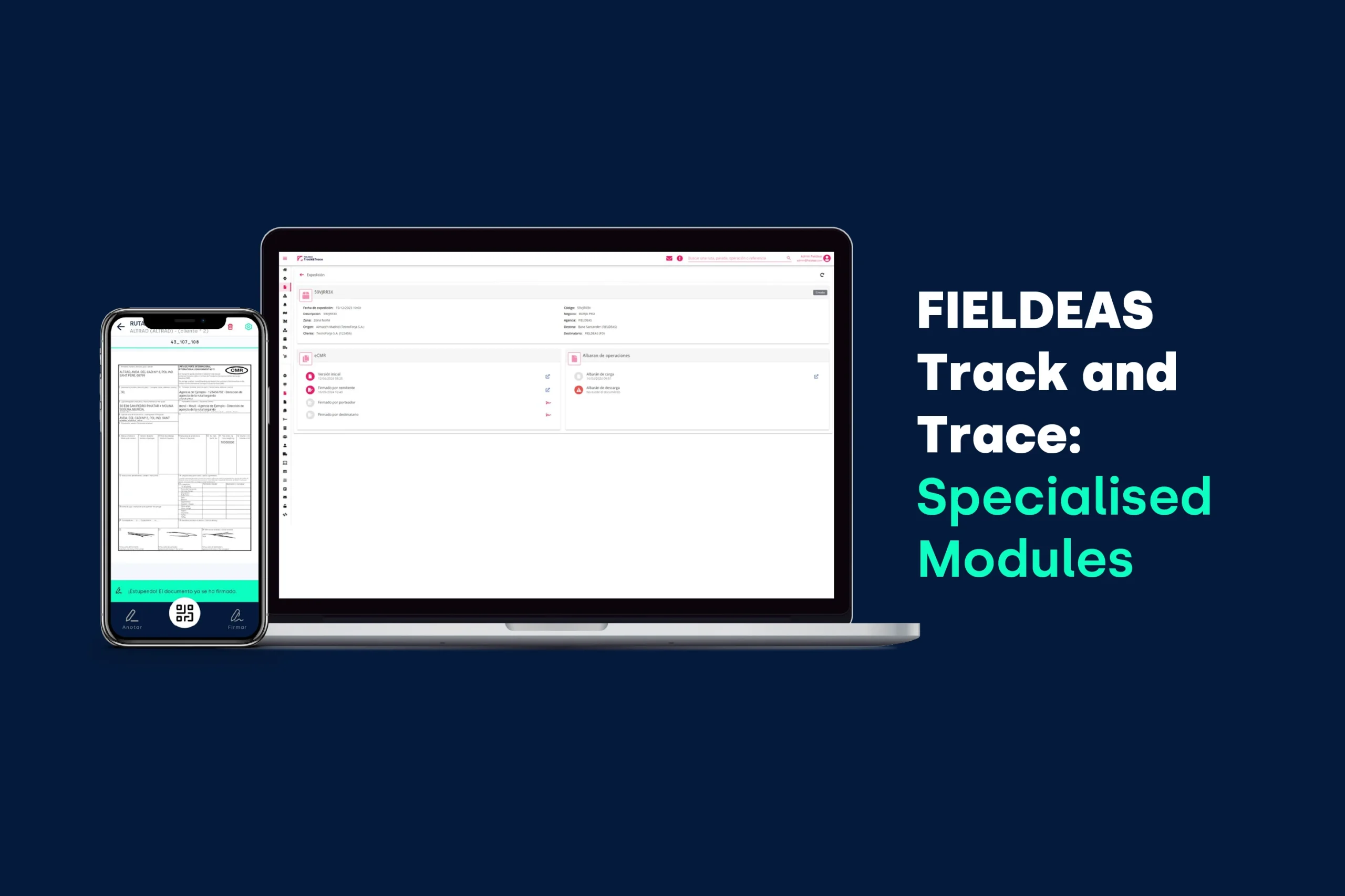


A few weeks ago we analyzed in the post FIELDEAS Track and Trace: the most complete modular solution for logistics and transport the structure of this solution and focused on the cross modules.
On this occasion, we will focus on the specialized modules, which are those that focus on the business through functionalities that allow the solution to be adapted to the different needs of the sector.
The specialized modules of FIELDEAS Track and Trace are:
On the other hand, let’s remember that, although each of these modules provides specific functionalities and benefits to each company and user, the union of all of them is what provides robustness and enhances the digitization of the supply chain.
The Planner allows the manager to create routes by grouping orders, either manually or according to periodic routes.
In addition, the route created by the Planner, in turn, is optimally organized under two premises:
In addition, the Planner also warns about possible violations of the route, such as load weights or limitations by vehicle type, as well as alerts for access restrictions and access limitations to ADR goods, thanks to the implementation of cartographies.
The main benefit of this module is that it ensures that routes are planned efficiently, realistically and cost-effectively.
Design shorter and faster routes, reducing kilometers and transit times. This translates into savings in fuel and vehicle maintenance costs.
Ensures that delivery or pick-up times are respected. Improves end-customer satisfaction by ensuring punctuality.
Possibility of generating automatic periodic routes or designing them manually. Allows to adapt to changing business needs.
Alerts in case of excess weight, incompatibility with certain vehicles, access limitations (ADR). Avoids legal non-compliance, penalties or operational risks.
Less planning time for the manager, allowing him to focus on monitoring and continuous improvement instead of repetitive manual tasks.
By reducing kilometers and time, it helps to reduce the carbon footprint, which contributes to more environmentally responsible logistics.
This module allows visibility and traceability of the execution of routes. At this point, we must take into account that we work with two types of traceability:
In addition, the possibility of having real-time tracking information allows to add to the route tracking data related to ETA (Estimated Time of Arrival), notifications about schedule changes, notifications about route changes…
The main benefit of the FIELDEAS Track and Trace Tracking module is that it guarantees total visibility of the transport, combining process traceability and physical geolocation.
It allows to know in real time the status of each route, ensuring control over each logistic event defined in the business.
It offers a complete view: both process execution and physical location. This provides greater security and confidence in the tracking of goods.
The ETA control and notification system makes it possible to anticipate delays or changes. This facilitates quick decision making to minimize customer impact.
Data collected from web, app, on-board systems or geofencing, thus ensuring flexibility and reliability in traceability.
The end customer receives transparent and updated information, which increases satisfaction by being able to anticipate the arrival of the goods.
Less time spent on manual route supervision and generation of metrics to improve future transportation processes.
This module expands the information already provided by the Expedition Tracking module, as it allows the inclusion of other types of routes, such as rail, sea and air routes.
In addition, this module ensures complete visibility and traceability, as it provides a view of all the routes involved in a shipment.
The main benefit of this module is that it provides global and integral traceability of intermodal shipments, improving coordination and control.
Extends visibility beyond road transport. It allows you to control land, rail, sea and air routes in a single system.
Facilitates tracking of shipments with multiple legs and modes of transport. This avoids fragmentation of information between different systems.
By having a complete view, bottlenecks or delays can be detected in any of the sections. This improves the ability to react to incidents.
Centralizing intermodal information optimizes time, costs and resources. It also provides valuable data for planning future operations.
The end customer has clear and consolidated information on the entire shipment, regardless of the means of transport, increasing transparency and trust.
It facilitates the management of global logistics operations involving sea and air transport. This makes it possible to adapt FIELDEAS Track and Trace to international supply chains.


The Container Control module allows you to manage and supervise the stock of containers at different levels, always in relation to the operation of each route.
Its main objective is to optimize the reverse logistics of packaging used in the transport of goods (pallets, drums, reels, etc.). Inefficient management of these elements can generate significant economic losses, since packaging represents an additional cost on the goods if it is not properly controlled.
In this way, this module facilitates stock management and the location of containers deposited with customers, offering complete traceability of those that are delivered, picked up or remain at each point.
Stock control is organized in two main areas:
In short, this module makes it possible to accurately record how many containers are unloaded, removed or remain at each loading or unloading point, ensuring total control over their life cycle and their value within the supply chain.
Ensures accurate container management throughout the entire transport chain, avoiding losses and improving traceability.
It allows to know the exact location and quantity of containers at stops and routes, avoiding uncertainty about the available stock.
Helps to better plan container utilization. This reduces costs associated with losses or excess inventory.
It records every movement (unloading, withdrawal or stay) and generates a history useful for audits and quality control.
Reduces errors in the manual management of containers and minimizes losses of reusable material.
Facilitates the efficient use of returnable or reusable packaging. This contributes to reducing waste and improving the environmental footprint.
The container stock is always linked to the logistics flow. In this way, a global view of transport is obtained together with asset control.
In order to calculate the carbon footprint, FIELDEAS Track and Trace applies reference methodologies such as ISO 14064 and the GHG Protocol.
Thus, the calculation is based on two key elements:
In the Carbon Footprint Calculation module, two data sources are used for emission factors, updated annually:
This FIELDEAS Track and Trace module provides a rigorous, traceable and certified calculation of GHG emissions associated with transportation.
Aligned with ISO 14064 andthe GHG Protocol, the main references in emissions calculation. Guarantees reports accepted by regulatory bodies and demanding customers.
Each calculation is based on objective activity data and official factors. This makes it possible to audit the information and justify the metrics.
It allows to know the real impact of transport operations onCO2 emissions and facilitates the identification of areas for improvement to reduce the carbon footprint.
Evaluates the environmental performance of different vehicles, routes and modes of transport. This helps to make decisions on fleet renewal, route optimization or transition to alternative fuels.
It provides accurate information on the environmental impact of expeditions, reinforcing the commitment to sustainability and corporate responsibility.
Generates key data for ESG reporting and emission reduction plans, contributing to achieving sustainability and carbon neutrality goals.
This module allows the digitalization of documents related to transport operations, such as the delivery note, control document, national consignment note or CMR, among others.
As Track and Trace is a system that allows interoperability between the different actors in the chain (shipper, logistics operator, transport agencies, driver, end customer), it makes sense that different documents can be attached to a transport at different times (delivery notes, control documents, vehicle documents, driver documents, etc…).
This digitization and incorporation of these documents into the system is carried out by various methods to increase the flexibility of use:
In many occasions it is necessary that this documentation is signed at the moment of making some operation. For this reason, this module also has several ways to perform this action. It can be configured with the following criteria:
In the post SeamLess eCMR of FIELDEAS: how does it work and how can it help you? you can learn more about the functionalities of this module.
The main benefit of the Transport Document module is that it ensures efficient, secure and paperless document management linked to each transport.
Convert any physical document into digital, reducing administrative costs and improving sustainability.
It makes it easier for shippers, operators, agencies, carriers and end customers to access documentation in the same system. This avoids duplication and loss of information.
Different ways of incorporation (creation, integration, capture), which allows to adapt to the operations of each company and moment of the logistic process.
It complies with legal and business requirements and is also suitable for different transportation scenarios and delivery points.
All documents are recorded in the system with access control, which facilitates audits and certifications.
Documentation always accessible from the web or the app. This reduces management times and enables automatic validations.


The Slot Management module allows the management of reservations of docks or slots of a logistics platform.
In order to be able to adapt to different scenarios, this module is configurable:
This module can also control bothoutbound andinbound loading and unloading operations.
On the other hand, the Slot Management module defines the processes according to the profile:
The main functionalities of the Spring Management module are:
In the post The comprehensive solution to manage all types of loading docks you can find more details about this FIELDEAS Track and Trace module.
The FIELDEAS Track and Trace Dock Management module optimizes the planning and use of docks, reducing waiting times and improving coordination in the logistics platform.
Avoids dock collapses thanks to advance planning. This improves area utilization and operator availability.
The pre-assignment of slots speeds up loading and unloading operations, which favors more agile and efficient logistics.
Adaptable configuration according to areas, vehicles, products and schedules. It adjusts to different types of platforms and logistic sectors.
Centralized control of operations, which allows us to detect incidents or delays and react immediately.
Managers have full control over the platform and carriers have access to only the necessary information.
Access control and layout visibility ensure a safer environment, reducing operational risks and facilitating traceability.
It favors an orderly flow of inbound and outbound operations, with direct impact on cost and time reduction and customer satisfaction.
The FIELDEAS Track and Trace Route Optimization module allows you to intelligently plan, manage and optimize transportation routes , combining manual and automatic planning with customizable business rules.
Its optimization engine calculates the most efficient sequence of operations, considering variables such as load capacity, time windows, service times or availability of logistics centers.
In addition, it integrates Slot Management, which reduces loading and unloading delays and synchronizes routes with the operational reality of each facility. Once the routes are in place, the system offers real-time visibility of compliance, ETA prediction and alerts for deviations, ensuring continuous control of the operation.
This module improves efficiency, reduces costs and emissions, and ensures more accurate, timely and sustainable logistics planning.
Automatically optimizes routes according to capacity, time and priorities, reducing kilometers traveled and improving the use of resources.
It calculates estimated time of arrival (ETA) and monitors in real time the progress of each route, anticipating delays and improving the level of service.
Minimizes unnecessary travel, downtime and fuel consumption, contributing to a more profitable and sustainable operation.
Integrates the management of loading and unloading slots, adjusting routes to actual warehouse availability and avoiding unnecessary waits.
It adapts to different types of transport (long distance, urban or multimodal distribution), ensuring accurate planning in any scenario.
It offers a global and real-time view of the transportation network, facilitating agile decisions based on reliable data.
With all this, we now know all the specialized modules of FIELDEAS Track and Trace, a flexible and complete supply chain visibility solution to digitize your supply chain.


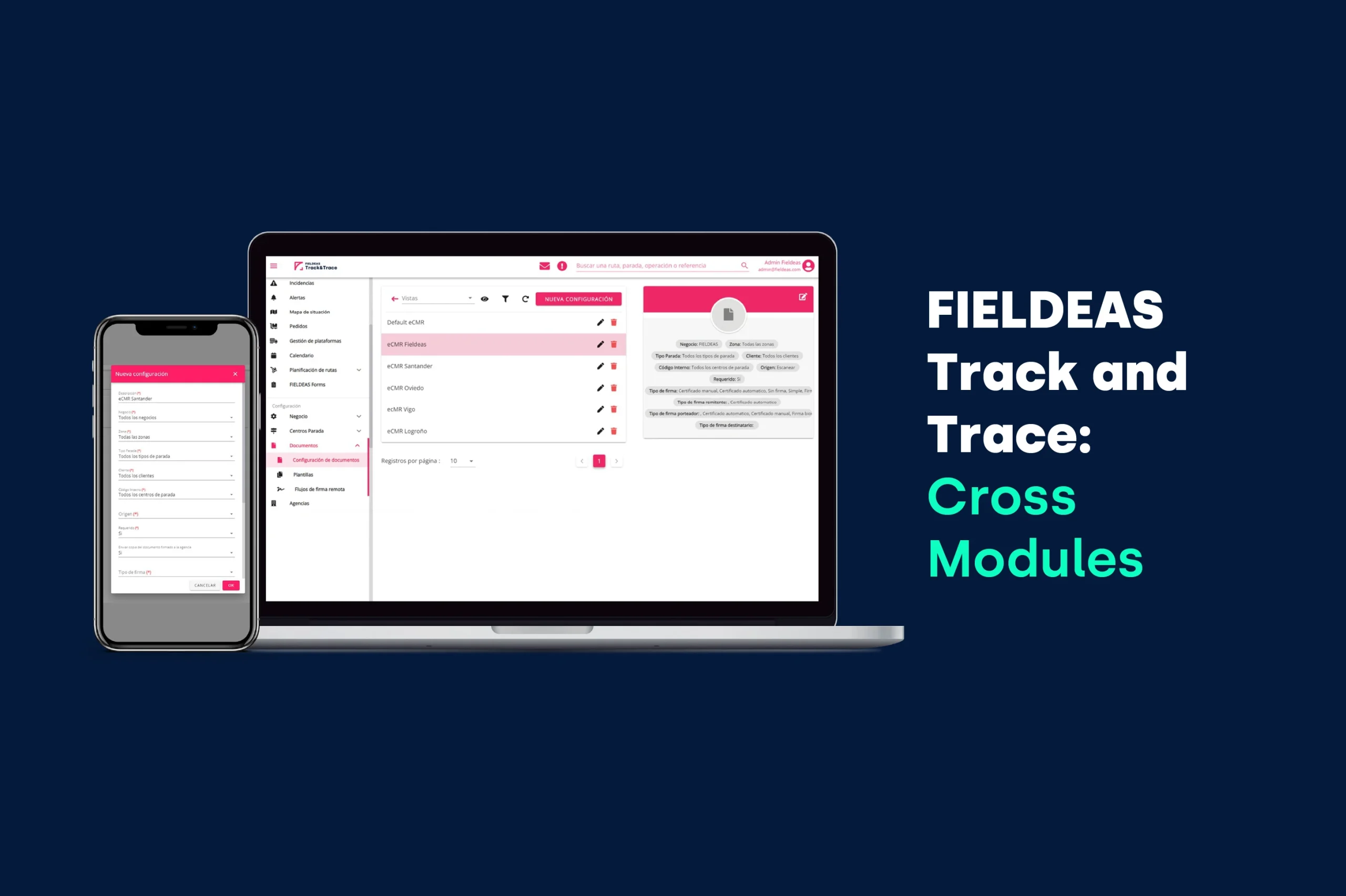
18 Dec 2025
FIELDEAS Track and Trace: the most complete modular solution for logistics and transport

12 Aug 2025
FIELDEAS: Multi-sector technological solutions with 100% Spanish capital. Local design, global impact

16 Jun 2020
5 Advantages of using Transportation Management Software

25 Nov 2025
Mandatory digital control document: what is it and how to digitize it?