Comprehensive digitization of road transport documents: mandatory vs. strategy
22 Jan 2026



The management of road transport documents is going through a key moment. The arrival of the mandatory digitization of the Control Document in October 2026 opens the door to the digitization of the rest of the documents.
In the post Road document digitization: from the transport control document to the eCMR we already talked about the strategic decision to digitize all official documents (those required by law). Now we go a step further to analyze how to digitally manage all the documents involved in a real road transport operation.
In this post we clarify which transport documents are actually used on a daily basis, which ones are required by law and how solutions such as FIELDEAS Track and Trace allow you to go far beyond the regulatory obligation, enabling full, continuous and frictionless traceability.
When we talk about road transport documents, we automatically think of the documents that are required by law: Control Document, Bill of Lading, CMR or International Waybill and even Delivery Note. However, in day-to-day transport operations, other documents are used that may not be “official”, but are very useful for the actors involved.
In practice, a road transport expedition involves multiple actors (shipper, logistics operator, carrier, driver and end customer) and each one generates and uses documents that do not always appear in the regulations, but are essential for the operation to work.
The difference between complying with the law and operating efficiently lies precisely in managing all transport documents in an integrated manner.
Thus, when digitizing document management in road freight transport, it is important to take into account the entire document ecosystem that is generated in real, daily operations, since it is inefficient to manage some documents digitally and others on paper.
The transport document chain begins before the truck is even on the road. The transport documents used by the shipper include:
None of these documents is legally required per se, but all of them are critical from an operational point of view. Their correct management makes the difference between a smooth load and a constant source of incidents.
The contractual shipper and the actual carrier are responsible for generating the Control Document (mandatory) and the Bill of Lading (mandatory in contracts over 150 euros and in ADR), as well as the CMR in the case of international transport. Taking this into account, if it is the shipper who issues the documents, he must add these to the list.
On the other hand, if it is the actual carrier who issues the documents, the Control Document, Bill of Lading and CMR must be added to the list if it is an international transport.
Alongside them, the carrier and logistics operator are commonly used:
These transport documents rarely appear in the regulations, but they underpin the day-to-day operations.


The driver is the point where all transport documents converge. In his day, legal documents and purely operational documents coexist:
From an operational point of view, the incident report and the associated photographic record are as important as the legal document itself. Without them, the management of damages, faults or delays becomes inefficient and conflictive.
At the point of delivery, shipping documents serve a critical function: closing the transaction.
They appear here:
Although most of these documents are not required by law, without them it is not possible to ensure traceability, correct invoicing and efficient claims management.
Once the transport is completed, the documentation returns to the office:
This documentary closure is key for audits, economic control and continuous improvement.
With the wide variety of documents used in transportation, without comprehensive digitization this process is often slow, manual and error prone.
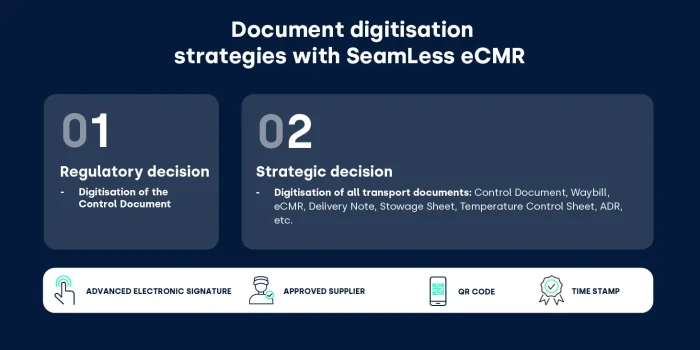
There are currently only two documents whose digitization will be mandatory. These are the Control Document, mandatory in digital format in October 2026; and the CMR or eCMR if we refer to its electronic version, expected to be mandatory in 2029 throughout Europe.
However, complying with regulatory precepts alone is not enough if the goal is to achieve an efficient, sustainable and connected supply chain.
The reality is that most of the transport documents that generate value, such as the delivery note or the stowage form, among others, remain outside the legal focus. And digitizing only what is mandatory maintains fragmentation.
A comprehensive digitization of transport documents allows:
It’s not just about compliance, it’s about transforming the way transportation is managed.
The digitization of the Control Document is only the beginning of the digital transformation that transportation will undergo.
Thus, overcoming the mandatory nature of document management and opting for strategy and competitiveness will allow companies to gain efficiency, traceability and visibility, not only of their document management, but also of the entire supply chain.
In this sense, the document digitization module of FIELDEAS Track and Trace, SeamLess eCMR, SeamLess eCMR and FIELDEAS Track and Trace, SeamLess eCMRallows the digitization of any type of transport document, regardless of its purpose and origin, and taking into account its legal characteristics in the case of official documents.
SeamLess eCMR is based on four pillars: flexibility, collaboration, security and efficiency, and enables two document management digitisation strategies:
In this way, SeamLess eCMR allows digitization to become a strategic lever of transformation, not a mere formality, since it offers comprehensive, collaborative document management with full legal and regulatory guarantees, enhancing efficiency, transparency and competitiveness.



25 Nov 2025
Mandatory digital control document: what is it and how to digitize it?
04 Dec 2025
Who is responsible for emission of the eCMR in road freight transport?
10 Dec 2025
Road document digitization: from the transport control document to the eCMR

15 Jan 2026
How does the digitalization of the control document affect drivers?