The 6 essential data of the road freight transport control document
12 Feb 2026



The road transport control document data is the key point of the digitalization required by the Sustainable Mobility Act.
This means that beyond the format and the design or title of the document, what really matters when presenting the Digital Control Document at a roadside check is that the administrative data required by law are reflected.
But what is this data? We look at it below.
The regulations governing the control document, the one that the Sustainable Mobility Law requires to be digitized in October 2026, are the following. Order FOM/2861/2013, of December 13, which regulates the administrative control document required for the performance of public transport of goods by road.
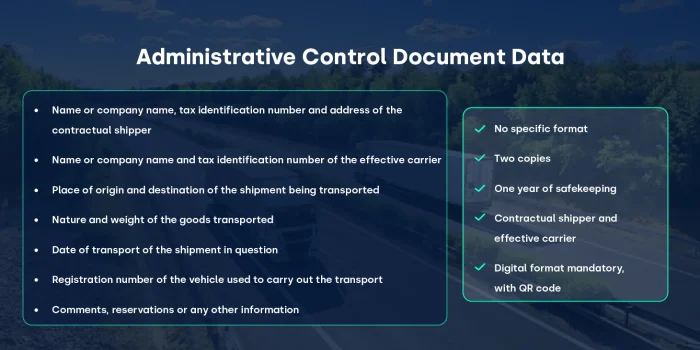
Article 6 defines the contents of the control document, which must include the following data:
In the case of an articulated combination, both the registration number of the towing vehicle and that of the semitrailer or trailer being towed by it must be shown.
In addition, if at the beginning of the transport operation there is a change of vehicle, this circumstance must be stated in the control documentation by the transport company.
On the other hand, whenever so requested by the parties involved, any observations, reservations or any other indications that they consider useful shall be recorded.
We already know what data should be included, now we need to know in what format it should be presented.
As we have already mentioned, the control document must not conform to any predetermined format .
This is reflected in Article 5 of the regulations: “The control document shall be freely editable, and may be adjusted to the model, format and denomination that best suits its purpose”.
This means that those companies that used the paper waybill as a control document can continue to do so, as long as it is digitized, since in transit verification security agents will need to scan a QR code with a URL where the document is uploaded.
Read the post In-transit verification of the Road Transport Digital Control Document; what to look out for for more information on roadside checks.
Even if the title of the document reads “Bill of Lading”, agents will only look to see that the administrative data on the control document is reflected.
As reflected in Article 3 of Order FOM/2861/2012, the control document is a document of an administrative nature, which must be carried on board the vehicle accompanying the goods during their movement.
In addition, it stipulates that, in contracts of continuous transport, there shall be as many control documents as there are shipments.
On the other hand, Article 4 determines the parties obliged to document shipments. That is to say, who are responsible for their issuance.
Thus, the contractual shipper and the actual carrier will be responsible for not formalizing the corresponding control document, as indicated in Article 7, which would entail penalties for both.
Likewise, this responsibility will be attributed to them in cases where the document is not carried on board the vehicle, unless the contractual shipper proves that the document was issued, in which case the latter will be exempted from responsibility.
Two copies of the control document must be issued on a mandatory basis.
One shall remain in the possession of the contractual shipper and the other in the possession of the actual carrier, the latter having to carry it on board the vehicle during the transport of the consignment in question.
In addition, both must keep a copy of the control document for at least one year.
The road to comprehensive digitization of all road freight transport documents has already begun in Spain with the approval of the Sustainable Mobility Law.
In addition, this same path has been initiated in international transport with the advancement of the eFTI Regulation, which comes into force effectively in 2027, at which time administrations will be obliged to accept electronic transport documentation.
Given this scenario, it is essential to go beyond the mandatory dates (such as October 2026) and understand that document digitization should not only be addressed as a regulatory requirement, but as a strategic decision for companies in the sector.
With full legal and regulatory guarantees, and complete support throughout the entire process, FIELDEAS Track and Trace with its Smart Docs Hub module is positioned as the trusted partner that supply chain companies need to successfully face the digital transformation in road transport document management:



15 Jan 2026
How does the digitalization of the control document affect drivers?

22 Jan 2026
Comprehensive digitization of road transport documents: mandatory vs. strategy
29 Jan 2026
Frequently asked questions (FAQs) on road transport documents

05 Feb 2026
In-transit verification of the Digital Control Document for road transport; what should be taken into account?