Download the free Lean Service white paper
Discover how to lead the future of business
13 Oct 2022
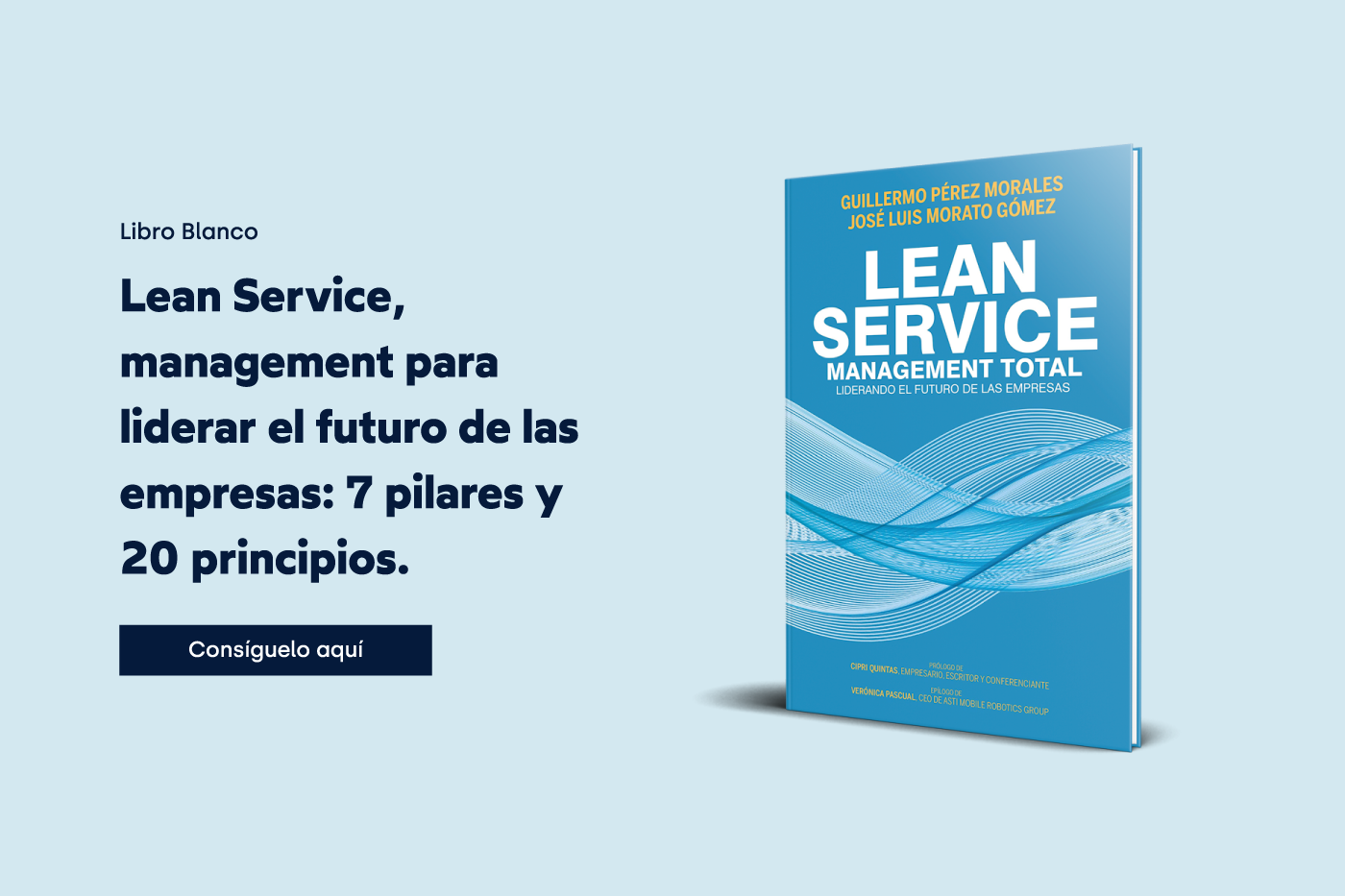


We are pleased to share the launch of the White Paper “LEAN SERVICE, TOTAL MANAGEMENT to lead the future of business: 7 pillars and 20 principles” an excerpt and executive summary of the book “LEAN SERVICE, total management”.
An excerpt and executive summary of the book “LEAN SERVICE, total management” written by Guillermo Pérez and José Luis Morato, published in October 2021 and edited by Gestión 2000.
According to its authors, “The current context requires open minds that understand that the world is moving towards a new paradigm, empowered by knowledge, which requires a business vision and purpose based on action and placing people at the center, key levers to transform and lead companies through 7 pillars: people, culture, management from purpose to action, mindset, strategy, technology and method and its 20 principles”.
From FIELDEAS we bring you the Sixth Pillar. Discover the philosophy of Lean Manufacturing to bring it to the field of services to any process, company or sector of the economy.
From today, October 13 until November 13 you will be able to download it for free. And, of course, if you want to buy the book, it is on sale in bookstores and major platforms.

Technology undoubtedly plays a leading role in our lives, and our LEAN SERVICE ecosystem for the 21st century embraces it as a fundamental pillar in its model with the intention of ensuring that the message endures over time. Thus, in our LEAN SERVICE approach, technology and digitalization are naturally incorporated into Lean thinking, culture, tools and processes.
Thus, in our LEAN SERVICE Manifesto, technology is based on three key principles for its development:
Principle 14: Commit to the digicultural transformation.
Principle 15: Establish a technolean strategy to incorporate technology in process improvement, always as a means to an end.
Principle 16: Incorporate digitization as a management element to streamline projects.
– Digiculture emphasizes a strategy that needs to be grounded to make sense of all the value it represents. Because we must not lose sight of the purpose and now more than ever.
– Tecnolean represents the natural combination and connection of technology and Lean methodology. A merger that brings great value to the companies, generating an unquestionable and valuable synergy between them.
– Only if the result of the PoC is satisfactory does it move to the DoC (development of concept) stage, a term created along the lines of the PoC and whose management model is normally under the TaaS (technology as a service, or pay-per-use) modality.
– For LEAN SERVICE, the incorporation of digitalization into its management model has been an extraordinary step forward in the total management model.
“When the transformation process is not accompanied by a change in culture and strategy, it often ends up becoming a very expensive problem.”
Silvia Leal Martín, digital-science communicator, expert in technology and trends.
“The four pillars of digital transformation are emerging technologies (major impact of IoT, especially geolocation sensors, big data and machine learning), process improvement (cost optimization, lead time reduction and inventory management), people (they demand fast delivery at low cost and with a lot of visibility of what’s going on) and, of course, the data that allow us to make quick decisions throughout the supply chain process”.
Luis Miguel del Saz Rodriguez, head of digital design, manufacturing & services at Airbus
“Technology should always be understood as a means, never as an end that allows us to improve the educational system by changing methodologies and adapting it to the needs of the 21st century.”
Elena Díaz-Alejo Rodríguez, manager corporate citizenship and public affairs, Samsung Electronics Iberia
“Lean’s impact on supply chain management also has strong synergies with its current challenges: digitization, sustainability and resilience.”
Ramón García García, Director of Innovation and Projects at Centro Español de Logística, CEL, and General Director of CITET’s Innovation Cluster.

Marketing Manager at FIELDEAS



05 Feb 2026
In-transit verification of the Digital Control Document for road transport; what should be taken into account?
The Digital Control Document for road transport represents a breakthrough in terms of efficiency, traceability and security. However, it also generates doubts and concerns, especially due to the fear of…
29 Jan 2026
Frequently asked questions (FAQs) on road transport documents
Numerous road transport documents are used in day-to-day road freight transport: control document, consignment note, CMR, delivery note, stowage form, waybill… All of road transport documents are relevant, but not…

23 Jan 2026
No-code electronic form: efficiency for companies with field operations
For companies operating in the field, achieving high levels of efficiency and competitiveness is an additional challenge, as digitizing processes becomes even more relevant. In this scenario, the electronic form…

22 Jan 2026
Comprehensive digitization of road transport documents: mandatory vs. strategy
The management of road transport documents is going through a key moment. The arrival of the mandatory digitization of the Control Document in October 2026 opens the door to the…