Road document digitization: from the transport control document to the eCMR
10 Dec 2025


The publication of the Sustainable Mobility Law in the BOE has already set a date in the calendar for the mandatory use of the electronic version of the transport control document: October 2026.
This milestone means that the countdown has been activated and that all companies in the road freight transport sector, without exception, are obliged from October 2026 to submit the administrative control document in digital format.
In addition, the Administration has already been prepared to accept digital transport documents for years by defining the control processes in the modification of the ROTT in June 2023.
However, it is well known that in a road transport expedition many more documents than the control document are used. What about the
The short answer is that it is not mandatory to digitize all transport documents in Spain, beyond the control document.
However, if we stop to analyze the strategy to be followed by companies in the coming months and years, the answer changes.
Digitizing all transport documents is undoubtedly a strategic decision, as it will allow all companies (loaders, carriers, operators) to gain competitiveness, flexibility and efficiency.
In addition, the eFTI Regulation makes eCMR mandatory before the end of the decade. While from 2027 it obliges Administrations to accept the electronic CMR, it contemplates 2029 to extend this obligation to all companies.
If we look at it, all the steps that are being taken at the regulatory level lead to the complete digitization of transport documents. Therefore, if it is now mandatory to digitize one of them, why not digitize the rest and get ahead of the regulatory tempos?
Although at first sight it may seem a complicated task, the truth is that there are solutions on the market that guarantee complete document digitalization with full legal and regulatory guarantees, as is the case of the document digitalization module of FIELDEAS Track and Trace, the SeamLess eCMR.
On a single platform, this solution allows the digitization of all transport documents, without exception.
In addition, it takes into account all the regulatory aspects that circumscribe each document and complies with the provisions of the amendment of the ROTT in June 2023 with respect to the characteristics that the administrative control documents in electronic format required in road transport must meet:
In addition, it allows documents to be presented to inspection services by means of a numerical code or QR code, in line with the ROTT.
The advantage of digitizing the administrative control document is obvious: regulatory compliance before the mandatory date. However, limiting digitization only to this document means adopting a minimal and reactive vision that leaves out much of the value that can be generated by the digital transformation of transportation.
In fact, digitizing all chain documents (waybill, CMR, delivery note) in a comprehensive manner generates benefits that go far beyond compliance:
If only the control document is digitized, the shipping documentation remains fragmented between digital and paper formats, generating friction, which translates into duplications, transcription errors, difficulties in locating information and inefficient archiving processes.
Therefore, digitizing the entire document flow makes it possible to unify the information in a single environment, creating a 100% digital file that can be consulted and traced from any point in the chain.
Much of the time lost in transport operations occurs in manual tasks such as exchanging paper documents, checking, filing or forwarding copies.
However, when all documents are digitized, these processes are automated and simplified, shortening loading and unloading times (one of the major concerns of the sector according to the Docks 2025 Study), speeding up invoicing and reducing administrative work.
The CMR, waybill or delivery note contain key information (damages, incidents, annotations, actual hours, signature…). If these documents remain on paper, this critical information does not arrive in real time and is not integrated into the management systems.
With full digitization, all parties have instant access to data, facilitating faster decisions, smoother communication and complete end-to-end traceability, as well as reducing friction between shippers and carriers.
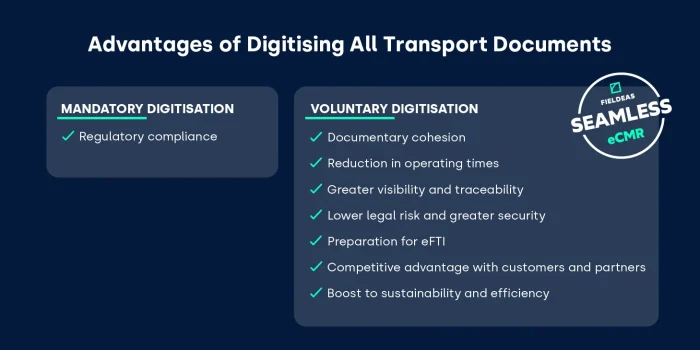
The complete digitization of the document flow provides valuable added legal security. Although digitizing only the control document is already a step forward, extending digitization to the CMR, the consignment note or the delivery note allows you to always work with complete, accessible and easily verifiable documents.
Having all documents in a secure digital environment facilitates traceability, reduces doubts about possible discrepancies and ensures reliable and orderly custody.
In addition, having documentation available in real time simplifies any verification, audit or exchange process with customers and administrations.
Focusing exclusively on the digital control document forces companies to make an effort to adapt now, and again in a few years, when the adoption of the eCMR will be made mandatory by the eFTI Regulation.
Adopting a comprehensive strategy now makes it possible to anticipate future obligations and avoid implementing digitization in phases that generate additional costs.
More and more customers and partners are demanding complete digital processes to improve their own supply chains.
Companies that limit themselves to complying only with the control document obligation will lag behind those that offer 100% digital, interoperable and sharable documentation in real time.
Thus, digitizing the entire document cycle becomes a business and service argument.
The total digitization of transport documents favors other relevant and even mandatory processes, such as measuring emissions, optimizing routes, analyzing times and improving overall transport efficiency.
These analyses require complete data, which is impossible if some of the documentation is still on paper.
Therefore, the integrated strategy allows us to move towards a more sustainable and efficient model, aligned with European green mobility objectives.
Although the industry is moving towards a framework where digitization will be the norm, choosing to digitize all transport documents on a voluntary basis makes it possible to anticipate these changes and transform the obligation into a competitive advantage.
Digitizing only what is required guarantees compliance, but digitizing in a comprehensive manner generates efficiency, visibility and real coordination among all actors in the chain.
This proactive approach facilitates a smoother transition, avoids further adaptations in the future and enables benefits to be realized from day one.
Therefore, rather than complying, it is a matter of seizing the opportunity to modernize document processes and stay one step ahead of the market.
The SeamLess eCMR module of FIELDEAS Track and Trace offers a complete document digitization solution for road freight transport. It is based on four pillars:
In this way, SeamLess eCMR allows digitization to become a strategic lever for transformation, not a mere formality, since it offers comprehensive, collaborative document management with full legal and regulatory guarantees, enhancing efficiency, transparency and competitiveness.


24 Nov 2025
eCMR in Spain: complete guide to the digital consignment note, regulation and time horizons

14 May 2024
How the advanced electronic signature must be integrated into the eCMR or electronic transport document

21 May 2024
eCMR, consignment note, control document, delivery note, are they the same?

25 Nov 2025
Mandatory digital control document: what is it and how to digitize it?