10 technology trends for 2018
Gartner talks about Intelligent Digital Mesh in its latest study
12 Dec 2017 Fuente: Gartner



For yet another year, the technology consulting firm Gartner has published a report on the 10 technology trends that will rule the digital landscape next year. Within these, IoT and Artificial Intelligence star on the list.
The report does not suggest implementing all of them to become a more innovative and competitive company, although it does suggest knowing each trend in order to analyze and justify which make the most sense to apply to our business. Or which ones we should pay special attention to. The main business concern, once again this year, is to stay informed, and in the midst of the digital current, to be prepared and not be left behind.
Today, the nature of the business no longer matters, because the future is in the hands of digital companies. Falling into the error of ignoring digitalization also means being prepared to assume that the company may end up disappearing. And for several reasons, among them, the lack of competitiveness for not responding to customer needs.
In the publication, the consulting firm speaks of ‘Intelligent Digital Mesh’, understood as the base, formed by models, platforms and services, capable of sustaining current and future digital businesses.
That technology is advancing faster than we are may not be entirely true, at least for now. For an application to be fully useful, it must keep up with the human pace, understand and learn from our brains and be able to anticipate situations.
For this and other reasons, artificial intelligence is critical this year, as is machine learning.
For combining the real and virtual world and resulting in a digitally enhanced and connected immersive environment.
The last part, which enables the viability of the new digital ecosystem, is the ‘mesh’, capable of establishing connections between all the elements involved in the architecture to make it possible.
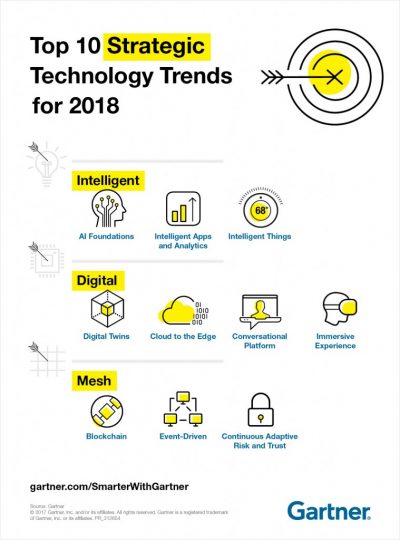
Taking into account all of the above, the 10 technology trends that we should take into account, looking ahead to 2018, and from a strategic point of view, are the following:
Creating systems capable of learning and acting autonomously will be one of the main technological challenges for software companies between now and 2025. The objective? Improve the decision making process.
Under the premise that in the coming years every application and service will incorporate Artificial Intelligence, software and service providers have to look at how to incorporate it to add value.
“Challenge your software and service providers to define how they will use AI to add business value to new releases in the form of advanced analytics, intelligent processes and advanced user experiences.” – David W. Cearley.
In the report, the term augmented analytics also appears. Understood as a strategic area that will use Artificial Intelligence to offer an improved data treatment process.
“Explore smart applications as a way to augment human activity, not simply as a way to replace people.” – David W. Cearley
Artificial intelligence applied to objects, with the aim of making these ‘smart things’ work autonomously or semi-autonomously. The next step that arises in the equation is the possibility of these elements acting together. A clear example is the military, which is exploring ways for drones to attack together, although with the future arrival of 5G networks, the possibilities will multiply.
The concept of digital twins refers to dynamic software that, placed in a machine, is able to predict behaviors and responses of its digital twin. That is, of such a machine. What this means is not only improved efficiency, but advanced simulation that will facilitate operation and analysis.
The report starts from the premise that the two concepts do not have to compete with each other and that they can work together to achieve better results. Thus, it is understood that the ideal model is one in which information processing occurs as close as possible to the source of information, minimizing its latency. Fundamental in a near future dominated by IoT.
Conversational platforms represent a paradigm shift in which the ability to interpret intentions will shift from user to machine. Similarly, while some will only provide simple answers, others will be able to understand and encourage more complex interactions. The challenge? Develop effective platforms that do not affect the user experience.
And, aiming higher, Gartner predicts an even greater evolution towards systems capable, for example, of listening to a witness testimony of a crime and creating a sketch of the suspect based on it.
Technological innovations point towards mixed reality, understood as that which uses real scenarios and combines them with Virtual Reality and Augmented Reality. The result of combining both technologies is an immersive experience, which is closer to the reality of how people see and interact with the world around them.
While it was initially expected that the infrastructure for digital currency would only affect financial institutions, now its irruption is extending applications to a wide variety of sectors, including industry, government, healthcare… Revolutionizing the business world as we knew it.
The advent of the above technological trends also means that business events can be detected more quickly, with business events being understood as any step that can be observed digitally. This is the case, for example, for status changes such as the completion of a purchase order.
Artificial Intelligence and IoT, among other technologies, will be able to quickly detect any situation requiring immediate action. In other words, the immediate knowledge of the completion of a purchase order will require a specific, agile and effective commercial action, which will be possible thanks to these solutions.
The study of these events will advance towards real-time situational awareness and advanced and rapid analysis.
On this last point, Gartner talks about the CARTA “Continuous Adaptive Risk and Trust” strategic approach. A continuous approach to adaptive risk and trust assessment that will become necessary in a fundamentally digital business environment, using increasingly sophisticated tools.
All of this creates a more complex security environment, which increases the threat potential and makes the CARTA approach necessary to take advantage of business opportunities and support real-time decision making.
While we will have to wait until 2018 to find out which companies will be most cutting-edge in their implementation, the firm says these will be the 10 technology trends that will impact the future of businesses going forward.
The entrepreneur always looks for change, responds to it and uses it as an opportunity. – Peter Drucker.

Marketing Manager at FIELDEAS



05 Feb 2026
In-transit verification of the Digital Control Document for road transport; what should be taken into account?
The Digital Control Document for road transport represents a breakthrough in terms of efficiency, traceability and security. However, it also generates doubts and concerns, especially due to the fear of…

29 Jan 2026
Frequently asked questions (FAQs) on road transport documents
Numerous road transport documents are used in day-to-day road freight transport: control document, consignment note, CMR, delivery note, stowage form, waybill… All of road transport documents are relevant, but not…

23 Jan 2026
No-code electronic form: efficiency for companies with field operations
For companies operating in the field, achieving high levels of efficiency and competitiveness is an additional challenge, as digitizing processes becomes even more relevant. In this scenario, the electronic form…

22 Jan 2026
Comprehensive digitization of road transport documents: mandatory vs. strategy
The management of road transport documents is going through a key moment. The arrival of the mandatory digitization of the Control Document in October 2026 opens the door to the…