The importance of visibility for full supply chain automation
23 Jul 2024


Visibility is the most desired goal for all companies in the transport and logistics sector, not only to have real-time information, but also to achieve supply chain automation.
In this sense, Oscar Lopez, CEO of FIELDEAS, during the second edition of FIELDEAS Talks, emphasized that achieving end-to-end visibility in the value chain goes far beyond knowing that the goods have arrived at the point in perfect condition, but it is about automating and being more efficient.
As we saw in the post “The concept of ecosystem in the digitalization of road freight transport” to achieve full visibility and automation of the supply chain, a digital ecosystem must be generated in which there is a balance between all agents, so that all parties gain, and where they do not act individually.
By generating a digital ecosystem, the entire chain can access data and make predictions automatically, allowing it to anticipate possible disruptions and provide faster and more efficient responses. Thus, when a company offers visibility to its environment, the rest of the companies that are part of it obtain the same visibility, which will allow them to automate their processes and, ultimately, become more efficient.
The word automation is indisputably linked to a long list of benefits, which are of very high value in the case of the transport and logistics sector. Thus, supply chain automation brings the following benefits:
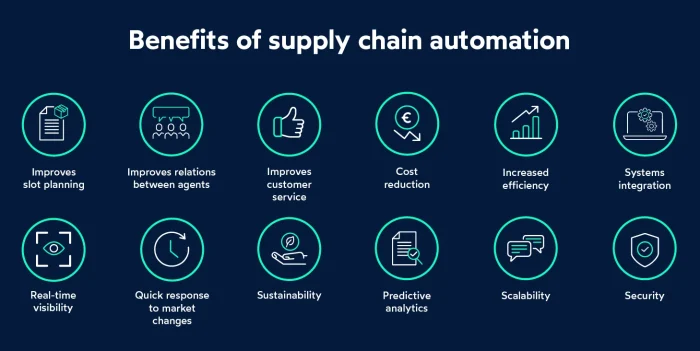
As we can see, all these benefits are a win-win situation for all parties: shippers, operators, transport companies and even consignees. This is key for supply chain automation to be a success and work as a seamless operation.
In addition to all of the above benefits, it is especially important to focus on how automation drives management by exception.
In short, management by exception is the proactive monitoring of the transportation process and is a medium to long-term process in which all processes are improved by applying technology wherever possible. In this way, the manager only has to focus on what the system alerts him to, allowing him to focus on other activities of greater value.
Thus, with the automation of the supply chain, management by exception is completely feasible and, in addition, the company will gain flexibility, efficiency and sustainability.
By obtaining data from different information sources, the system determines patterns, so that when they are not met, it is able to issue a warning signal to manage that incident. In the post “How to improve your transport operations with management by exception” we explain in more detail how management by exception is achieved in transport and logistics.
The key tool to obtain complete supply chain visibility is to have a platform designed for it.
In this sense, the most advanced, flexible and secure Supply Chain Visibility platform on the market, FIELDEAS Track and Trace, is capable of bringing together and connecting in a single point all the technological tools that serve as a source of information for tower control, providing full visibility of operations, which subsequently leads to automation.




05 Feb 2026
In-transit verification of the Digital Control Document for road transport; what should be taken into account?
The Digital Control Document for road transport represents a breakthrough in terms of efficiency, traceability and security. However, it also generates doubts and concerns, especially due to the fear of…

29 Jan 2026
Frequently asked questions (FAQs) on road transport documents
Numerous road transport documents are used in day-to-day road freight transport: control document, consignment note, CMR, delivery note, stowage form, waybill… All of road transport documents are relevant, but not…

23 Jan 2026
No-code electronic form: efficiency for companies with field operations
For companies operating in the field, achieving high levels of efficiency and competitiveness is an additional challenge, as digitizing processes becomes even more relevant. In this scenario, the electronic form…

22 Jan 2026
Comprehensive digitization of road transport documents: mandatory vs. strategy
The management of road transport documents is going through a key moment. The arrival of the mandatory digitization of the Control Document in October 2026 opens the door to the…