Real-time data for hyper-connected supply chains
Conclusions of the round table: "Technology and innovation as indispensable allies" Summit 2021 'Driving Sustainable Mobility from Business'.
15 Feb 2021
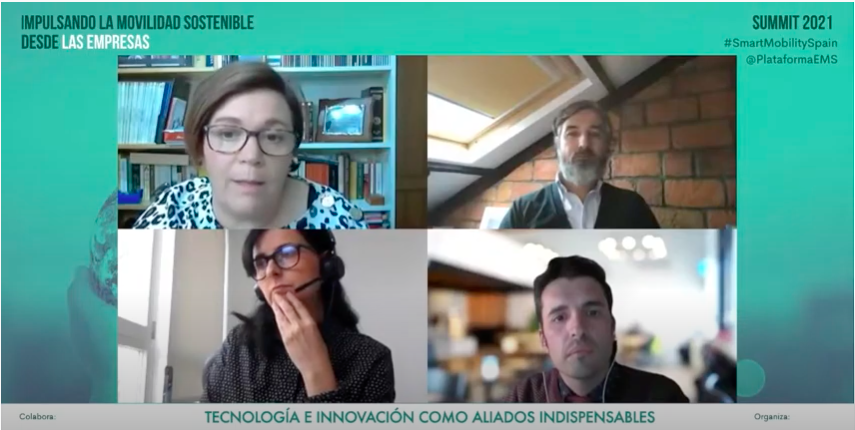


Óscar López, CEO of FIELDEAS, has analyzed in the recently held ‘Summit 2021 Driving Sustainable Mobility from Business’, the role played by real-time data analysis as a key factor to achieve hyperconnected, more efficient, sustainable and service-focused supply chains.
In this sense, Lopez points to the ability of data management to add value and transform the supply chain, in order to make it more efficient from the point of view of planning, optimization and sustainability.
Using data as raw material, the company seeks to have an impact on each of the points that make up the chain in order to make appropriate decisions to ensure the correct operation of the entire system.
The second stage is to monitor the data in real time, taking into account that the information travels with the merchandise, has multiple origins and must be accessible to each and every one of the actors in the chain.
Finally, FIELDEAS analyzes in a last phase the data from a business perspective and not as an isolated record.
End-to-end visibility through real-time data collection is the key to more efficient and sustainable supply chains.
This integrates all data in a seamless flow with an overall picture that gives context to an entire service in a holistic manner to provide end-to-end visibility.
The aim is to have reliable information that allows the best possible decision to be made based on what is happening at any given moment.
The aim of the process is to manage a large amount of data, integrate them to avoid their dispersion, contextualize them and make the most of them from a business perspective, as well as to provide feedback to obtain the information in the shortest possible time, as Óscar López explains.
Likewise, in this whole process, the elimination of paper plays a fundamental role due to the savings in management costs and the management improvements it entails.
All this makes it possible to develop a hyper-connected supply chain, which places the customer at the center of all activity.
To illustrate the capabilities offered by FIELDEAS work, López analyzed the project developed in collaboration with Repsol.
This initiative stands out for its great magnitude, as it is a project to manage more than 1,000 daily transport routes.
Similarly, in this particular case, it is a shipper that does not work with its own fleet, but collaborates with more than 80 transport agencies, which makes for an extremely complex environment.
For this case, FIELDEAS has developed a SaaS solution for Repsol based on FIELDEAS Track and Trace which integrates all the information that has been collected through a API, of a web and mobile applicationThe objective is to capture it visually and intuitively in real time.
Despite the size of the project, the development of the project has has made it possible to increase the quality of service and to optimize activitiesthrough a system that provides end-to-end visibility through real-time data, with the aim of building a hyper-connected, more efficient, sustainable and service-focused supply chain.
To access the recorded event of the ‘Summit 2021 Driving Sustainable Mobility from Business’ held on February 11 click here.

Marketing Manager at FIELDEAS


05 Feb 2026
In-transit verification of the Digital Control Document for road transport; what should be taken into account?
The Digital Control Document for road transport represents a breakthrough in terms of efficiency, traceability and security. However, it also generates doubts and concerns, especially due to the fear of…
29 Jan 2026
Frequently asked questions (FAQs) on road transport documents
Numerous road transport documents are used in day-to-day road freight transport: control document, consignment note, CMR, delivery note, stowage form, waybill… All of road transport documents are relevant, but not…

23 Jan 2026
No-code electronic form: efficiency for companies with field operations
For companies operating in the field, achieving high levels of efficiency and competitiveness is an additional challenge, as digitizing processes becomes even more relevant. In this scenario, the electronic form…

22 Jan 2026
Comprehensive digitization of road transport documents: mandatory vs. strategy
The management of road transport documents is going through a key moment. The arrival of the mandatory digitization of the Control Document in October 2026 opens the door to the…