In-transit verification of the Digital Control Document for road transport; what should be taken into account?
05 Feb 2026



The Digital Control Document for road transport represents a breakthrough in terms of efficiency, traceability and security.
However, it also generates doubts and concerns, especially due to the fear of sanctions in case the document does not comply with regulatory requirements when a roadside control takes place.
Since the approval of the Sustainable Mobility Law, the regulatory framework is clear: the Control Document can be issued in electronic format, but it must meet a series of technical and operational requirements to be valid for in-transit verification.
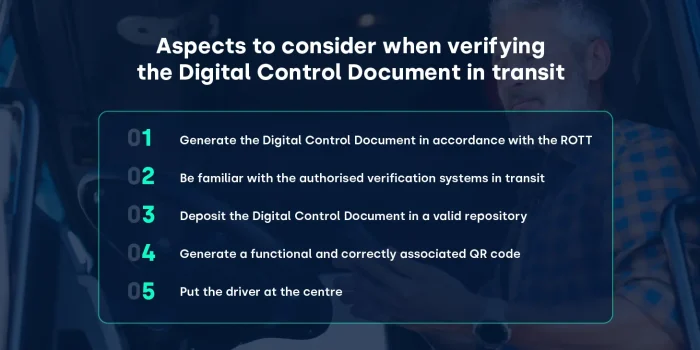
In this post we analyze the key aspects that must be taken into account to ensure that the Digital Control Document for road transport successfully passes any roadside check.
As we have already seen in previous posts, the digitalization of transport documents must comply with a series of requirements to be valid.
This digital transformation must be carried out in compliance with the provisions of the Regulations of the Land Transport Management Law ( ROTT). This implies:
Failure to comply with any of these points may result in the document being considered incorrect or incomplete at a roadside check, with the consequent risk of a penalty.
One of the main steps to avoid problems is to understand how in-transit verification is actually performed.
The ROTT provides two official ways of verification by the Land Transport Inspection Services or by the agents of the surveillance forces:
The agent provides the driver with a code in numerical format, which the driver or the transport company must enter in the repository of the Ministry of Transport, through its official web application.
This system allows the Administration to access the deposited document and check its validity.
The second and most common way is to read a QR code containing the URL where the Digital Control Document is stored.
In this case, the document:
Correctly generating the Digital Control Document is not enough if it is not deposited correctly.
As mentioned above, the regulations establish that the document must be deposited in a repository with a domain certified by the Ministry of Transport and Sustainable Mobility.
This repository must guarantee:
A file stored only on a local device, in an e-mail or in a system not prepared for official verification does not meet this requirement.
This point is critical, since in an in-transit verification the agent does not evaluate how you manage the document internally, but whether he can access it immediately through the authorized channels.
The QR code has become the most agile form of verification.
For the Digital Control Document to be valid at a roadblock, the QR must:
It is not enough to have a QR. If the link is broken, requires credentials not available to the agent or does not show the correct document, the check will not pass.
In addition, it is important that the QR is up to date and corresponds exactly to the Control Document of the transport being carried out at that moment.
One of the points included in the regulations governing the Control Document is that it must always be on board the truck accompanying the goods.
Therefore, it is important to put the driver at the center in the digitization of the Control Document.
In a roadside check, the driver is the person who interacts with the agents. If he cannot show the QR, does not know where to find it or does not have access to the document, the problem is not technological, it is operational, and can end in a sanction.
The regulations require the document to be available during transport, which implies:
This can be solved through mobile applications, web platforms or integrated systems, as long as they guarantee simplicity and availability.
The document digitalization module of FIELDEAS Track and Trace takes into account all these regulatory considerations and, in addition, guarantees the full effectiveness of the Digital Road Transport Control Document in the event of a roadside control.
Thus, the in-transit verification flow of the FIELDEAS Track and Trace SeamLess eCMR is drawn as follows:
Solve all your doubts about the Digital Control Document and the rest of road transport documents in our FAQs post: Frequently Asked Questions (FAQs) about road transport documents.


21 May 2024
eCMR, consignment note, control document, delivery note, are they the same?

25 Nov 2025
Mandatory digital control document: what is it and how to digitize it?
10 Dec 2025
Road document digitization: from the transport control document to the eCMR

22 Jan 2026
Comprehensive digitization of road transport documents: mandatory vs. strategy