8 benefits of optimize loading and unloading dock management
09 Apr 2024


Failure to optimize the management of loading and unloading docks in logistics platforms or distribution centers is one of the most critical points in the supply chain and is often the most critical main source of conflict between shippers and carriers due to the long waiting times they sometimes face.
In this situation, the most effective solution is to optimize the management of loading and unloading docks. In addition to being a great competitive advantage for the shippers themselves because it improves productivity, optimizing waiting times also helps to improve the working conditions of professional drivers. This leads to an improvement in the reputation of the profession and can solve the driver shortage, a critical problem not only for the road, but for the logistics sector in general.
The question is: how to optimize spring management? The answer is simple: with digitization.
Having a loading and unloading dock optimization system is essential to solve the above mentioned problems. In addition, it brings a series of benefits that boost the competitiveness of companies and the sector.
Here are eight main benefits of spring management systems.
Before September 2022, drivers had to assume the waiting time at logistics platforms until the completion of loading or unloading of goods. This meant not only an economic cost for the transport companies, but also a detriment to the working conditions of the drivers.
Against this backdrop, Royal Decree-Law 3/2022 on measures to improve the sustainability of road freight transport and the operation of the logistics chain was approved in March 2022. In this text, the maximum waiting time for a truck in a logistics platform was set at one hour. Thus, if this time is exceeded, the carrier will be able to claim compensation for stoppage.
This new regulation forces shippers to reduce waiting times for loading and unloading, and this is where dock management systems, such as FIELDEAS Track and Trace, become particularly important.
Efficient management of loading and unloading docks minimizes waiting times for trucks and drivers, which helps increase productivity and reduces operating costs.
According to our experts, optimizing loading and unloading docks reduces waiting times by 30% and also improves the timeliness of deliveries to end customers by 20%.
By optimizing processes at loading and unloading docks,bottlenecks can beeliminated and vehicle loading capacity maximized, leading to more efficient operations.
In particular, the FIELDEAS Track and Trace dock management system increases order processing capacity by 15% and, in addition, moves from reactive management to predictive monitoring thanks to real-time information.
Proper dock management allows optimal use of available space in the warehouse or distribution center, which can result in better utilization of resources and reduced storage costs.
The real-time information provided by a slot management system makes it possible to anticipate resource availability and demand, allowing for better space management.
In addition, the FIELDEAS Track and Trace dock management system can be easily integrated with the company’ s WMS for more accurate data and improved storage space management.
Information is power and, therefore, integrating a dock management system is a safe strategy.
If operators know how many trucks are going to arrive, what type of cargo and when loading and unloading will take place, they gain knowledge, can plan their work and do not leave room for improvisation.
Thus, efficient management of loading and unloading docks can help reduce the risks of accidents and injuries in the workplace by implementing appropriate safety measures and ensuring regulatory compliance.
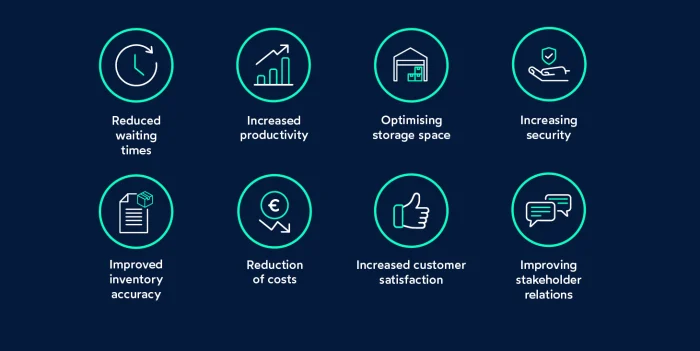
Just as a system to optimize dock management helps optimize storage space, it also improves inventory accuracy.
Again, it is the real-time information obtained from systems integration that allows for more accurate inventory tracking, reducing the possibility of errors and loss of merchandise.
Reduced waiting times are synonymous with reduced costs. As we have seen, dock management systems improve productivity, optimize storage management and inventory control, and increase safety, resulting in considerable cost reductions for shippers or operators.
But, in addition, reducing waiting times also means cost savings for carriers, in terms of labor, fuel and vehicle maintenance, among others.
The ultimate goal of any company is good customer satisfaction. In this regard, managing loading and unloading docks efficiently can lead to improved delivery times and order accuracy, resulting in higher customer satisfaction.
We started this post by explaining that waiting times in logistics centers is one of the most important sources of conflict between shippers and carriers.
As we have seen, by implementing a dock management system, waiting times are reduced and, in addition, it allows all the agents involved to have real-time information and to be able to carry out more accurate planning.
All in all, we can state that collaboration is the most important benefit of optimizing dock management through a software system.
It is important to have a collaborative model in dock management and to integrate carriers as a key player, because this eliminates disputes between warehouse personnel and drivers, resulting in increased operational capacity.
These eight benefits combined can have a significant impact on a company’s profitability and competitiveness in the logistics and transportation sector.
In addition to the benefits mentioned in the previous point, it is also important to highlight the following:
After knowing the main benefits of optimizing dock management, we already know that a specific software solution for slot management offers visibility, allowing to anticipate demand and availability of resources, as well as allowing the inclusion of all actors involved in slot management, which reduces disputes between carriers and shippers.
The ultimate goal of slot management systems, such as FIELDEAS Track and Trace, is therefore to improve planning in order to gain flexibility, efficiency and consensus.
The management of loading and unloading docks is an integrated module within the FIELDEAS Track and Trace solution, a control tower that allows visibility of all transport processes, regardless of the model and mode of transport.
The main feature of our Supply Chain Visibility is its flexibility, which makes it easy to manage both in-house and outsourced fleets, various logistics facilities and to take into account complex logistics activities such as cross-docking.



13 Feb 2024
Improve your operations by optimizing dock management in a collaborative way
15 Jan 2024
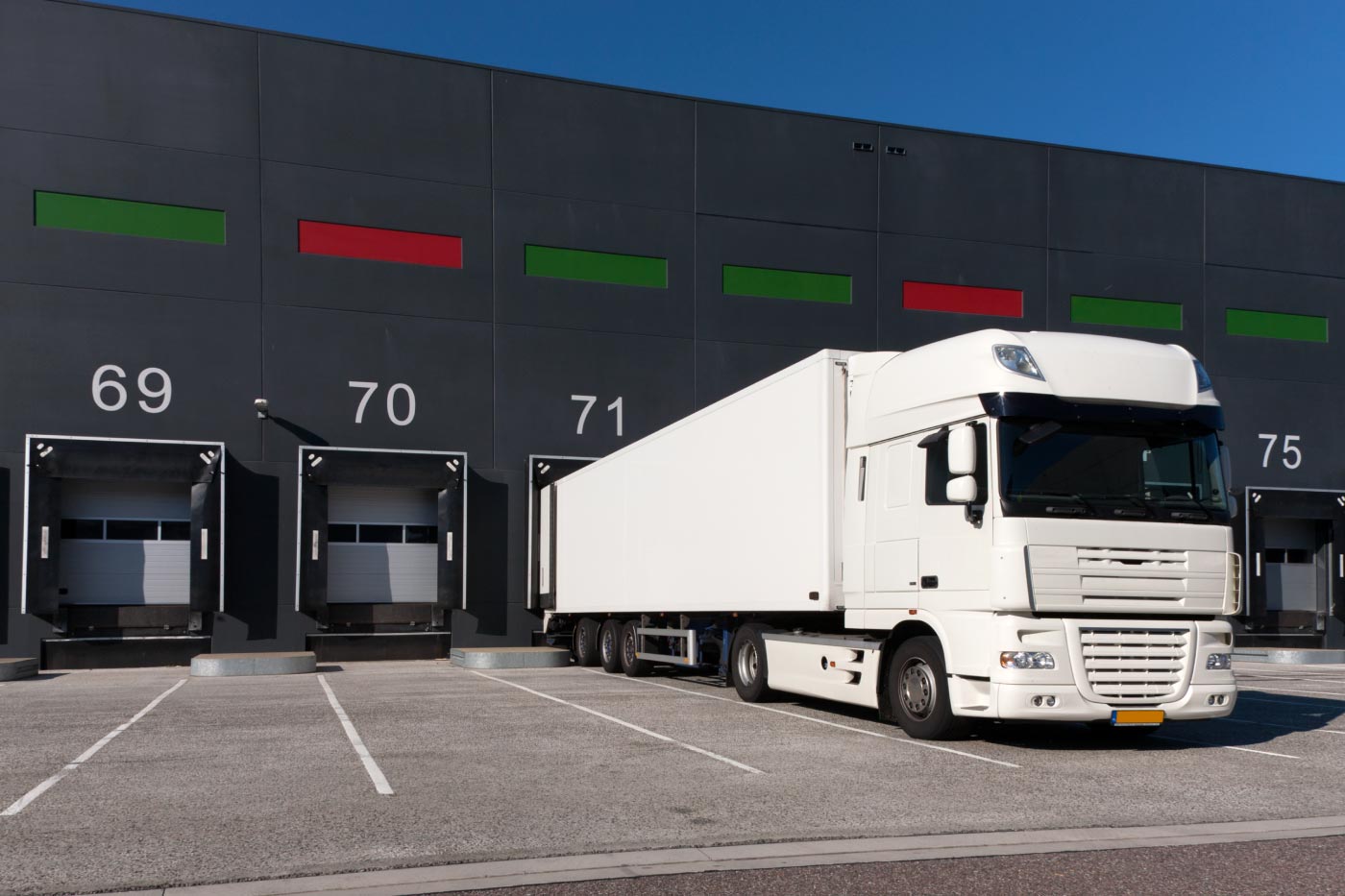
How to improve the management of loading docks in warehouses

20 Feb 2024
The importance of having an eCMR system with full legal assurance

24 Nov 2025
eCMR in Spain: complete guide to the digital consignment note, regulation and time horizons